
Outlets and switches mounted in a wet wall can carry water behind their covers. Do not touch them and do not run a cord into your damp wall; keep away until the power to that circuit is off.
Service · Santa Monica, CA
Water in the Walls After a Storm in Santa Monica, CA
The storm is over, yet your wall still sweats cold to the touch, the baseboard has opened a gap at the floor and a tide line is climbing the paint. Water in the walls after a storm sits between your wallboard and your framing, where air cannot reach it. Professional drying pulls that water out of the studs and the batting, so call before your wall holds it for good.
What you are seeing
A wall that holds the storm after it ends
Water that enters through your roof edge, a window frame or a cracked exterior wall does not always show itself. It runs down inside the wall and collects at the bottom plate, and the surface tells you very little about what your wall holds.
- A tide line on the paint
Moisture is climbing from the floor and leaving a mark as it goes.
- A cold, clammy surface
Wallboard is holding water that has not evaporated.
- A baseboard that gaps or lifts
The wood is swelling as water reaches the bottom of your wall.
- A stain that returns after you repaint
Moisture is still coming from inside the wall.
Keep your hands off damp outlets and switches in your wall, then call before the water settles into your framing.
(424) 437-1293Safety protocol
Wiring lives inside that wall
Loss risk
What trapped water does to the cavity
A wall is built to stay closed, which is exactly why wet material in it stays wet. Water drains downward and pools at the bottom plate with nowhere to go.
Wind-driven rain that reaches the sheathing behind stucco or siding runs down the furring channels and over the flashing laps, then pools where the sheathing meets the sill plate.
- Batting
It soaks up the water, slumps and keeps the wallboard wet from behind.
- Studs and plates
Lumber takes in the moisture slowly and releases it more slowly still.
- Paper facing
The paper softens first, then the gypsum core crumbles from within.
- Bottom plate
Water settles here and stays long after the upper wall feels dry.
Restoration scope
What drying water out of a wall involves
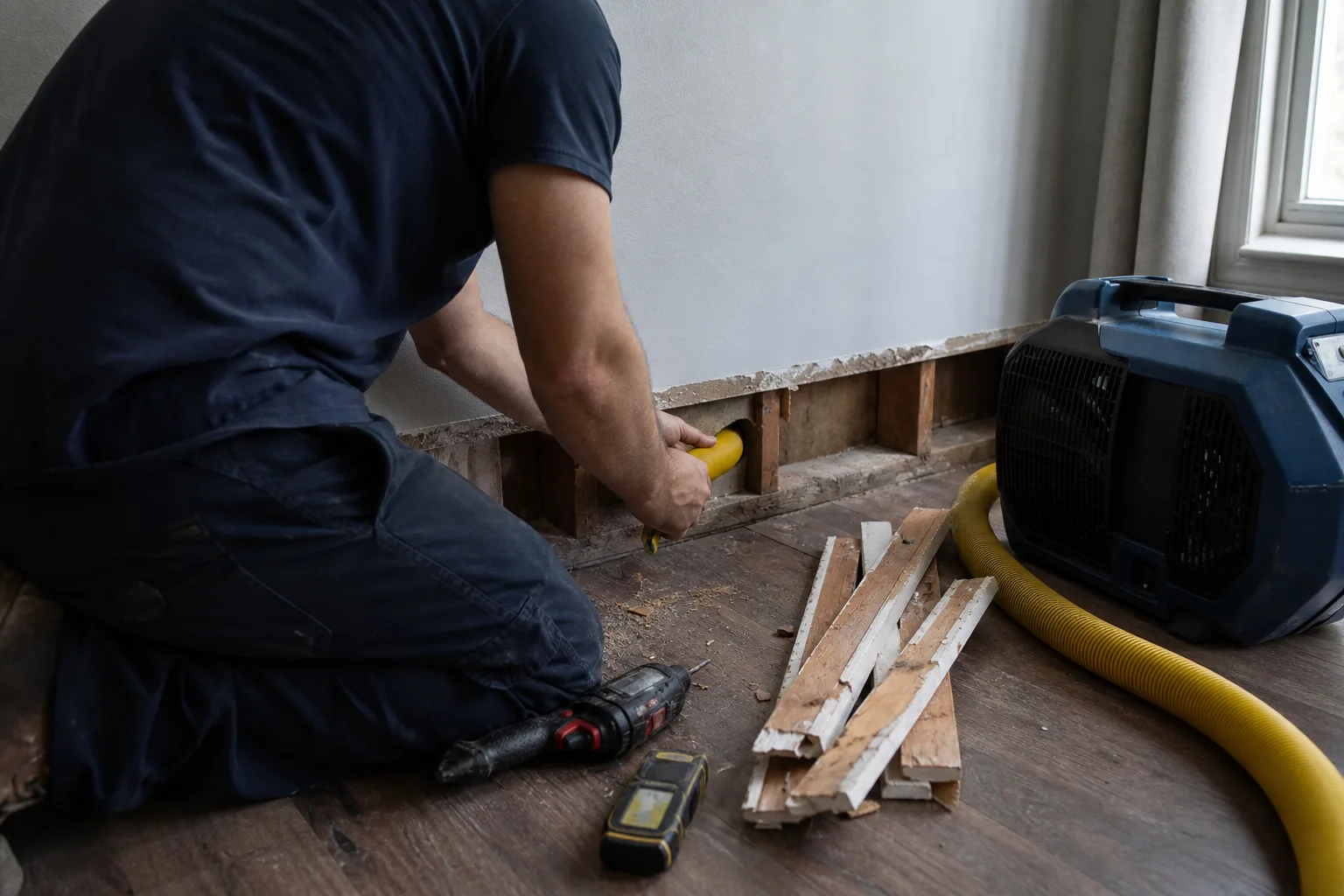
Mitigation reaches inside your wall instead of drying only the surface. The goal is to empty the wall, dry the lumber and keep as much of your wall as possible.
- Height-by-height metering
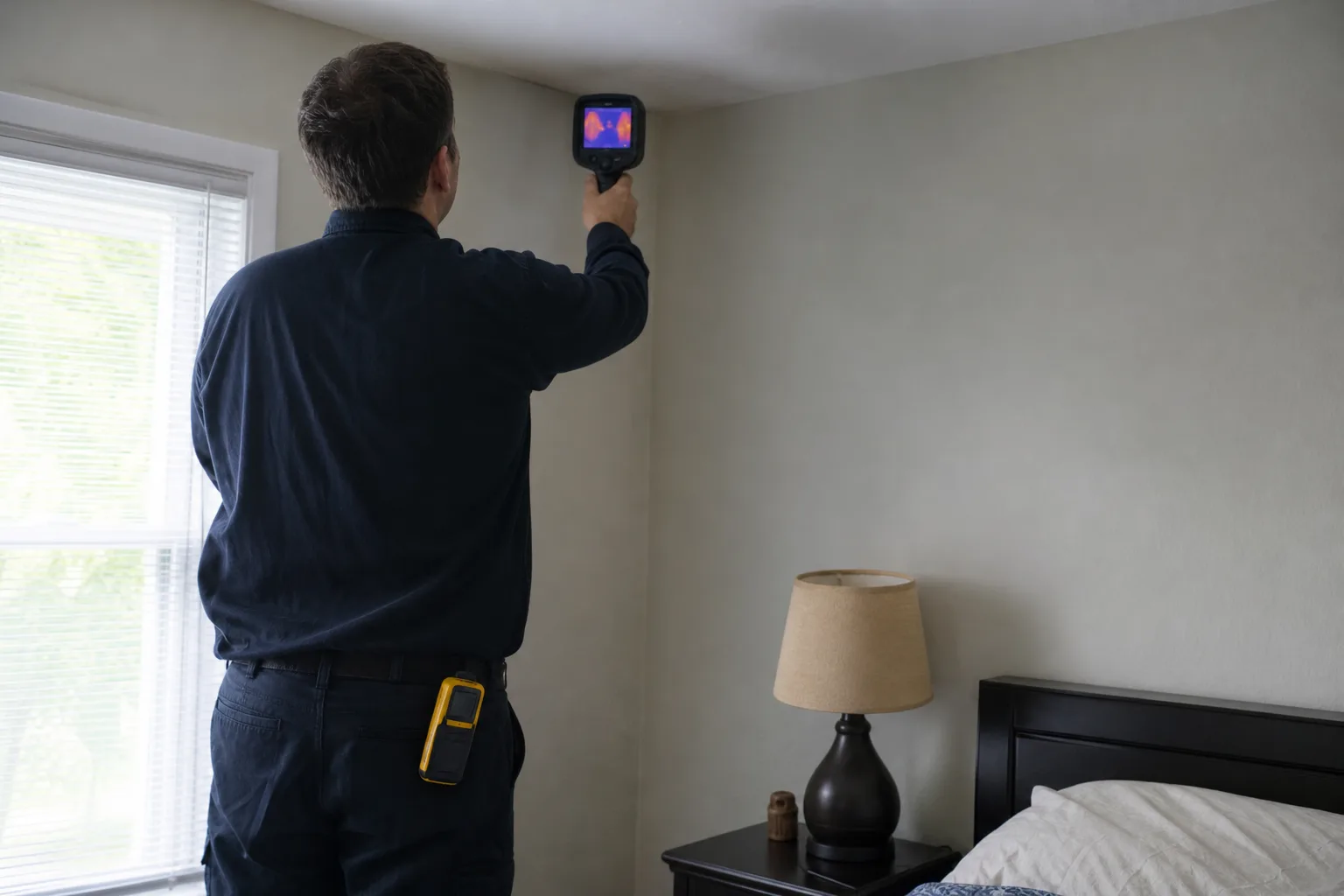
Meters read across the wall at several levels to find where the water sits.
- Base ports
Small, controlled ports at the bottom give trapped water a way out.
- Batting removal
Soaked batting comes out so it stops pressing water back into the wallboard.
- Framing dry-down
Controlled airflow and moisture removal run through the opened wall until readings fall.
Service sequence
How a wet wall is dried from the inside
Moisture survey
Readings at several levels show how high the water climbed in your wall.
Ports opened
Controlled openings at the base give the trapped water a way out.
Batting pulled
Soaked batting leaves your wall and the standing moisture drains.
Plates and studs dried
Controlled drying works through the lumber and the bottom plate.
Wall cleared
Meters match a dry reference before anyone closes the wall.
Local detail
A long storm leaves a wall wet well after it ends
The City's hazard mitigation plan describes the storm of February 4 to 8, 2024 as a slow-moving atmospheric river, and water that enters during a storm like that keeps soaking the wall behind the stain. Call once a stain or a clammy wall appears in your home instead of waiting for the sky to clear.
Triage order
Why the wall will not dry by waiting
A closed cavity does not dry itself. Every week your wall stays wet, more of your paper facing, your baseboard and your framing absorbs the water, and a drying job drifts toward a tear-out.
Storm water often enters at a parapet cap, a balcony slab or a stucco crack, and it travels well below that point before it shows. Your wall can look sound at eye level while the lower plate sits in water.
Keep away from damp outlets and call about water in the walls of your Santa Monica home in Los Angeles County while the cavity can still be dried from the base.
Scope: Emergency extraction and structural drying clearance only. Structural rebuild and finishing carpentry are contracted separately.
Service area
Santa Monica ZIP codes
- 90401
- 90402
- 90403
- 90404
- 90405
- 90406
- 90407
- 90408
- 90409
- 90410
- 90411
Every responding technician is independent. Before work begins, confirm the technician's license, insurance and pricing with them directly.
Common questions
Water in the wall questions in Santa Monica
How can you tell water is inside the wall?
Bubbling paint, a cool, clammy surface, a lifting baseboard or a stain that returns after you repaint all point to water in your cavity.
Does the wall have to come down?
Not always. Controlled openings at the base often let your cavity drain and dry, and only material that cannot recover comes out.
Will repainting hide the problem?
No. Paint covers the surface while the water stays in your framing, and the stain returns once your wall draws moisture again.
Water damage keeps spreading until it is dried.
Call from Santa Monica before the water reaches the next room, the subfloor or the framing behind your walls.