
Water is pooling on your floor, a stain is widening overhead, or a wall feels damp and soft under your hand. Water damage restoration in Santa Monica starts with two questions: where the water came from, and how much of your building it has soaked.
Santa Monica · Los Angeles County
Emergency Water Extraction in Santa Monica, CA
Water damage restoration starts at the source. Pick the line that matches what you are looking at, then call before it spreads.
- Name the source: a pipe, the weather or somewhere you cannot see.
- Hidden moisture keeps damaging framing after the surface dries.
- Everything starts with one phone call.
 Call to stop the spread(424) 437-1293
Where is the water coming from?
- 1 A pipe, fixture or appliance Supply lines, water heaters, washing machines and drains inside the building.
- 2 The sky or the ground Roof leaks, storm water at a door or garage, ground water rising around the foundation.
- 3 Somewhere I cannot see Damp smell, stains or warped flooring with no visible source: inside a wall, under a floor or from a unit above.
Why call
Why the first call matters in Santa Monica
Moisture keeps moving after the water stops. Call as soon as you see it spreading, while drying in place is still possible.
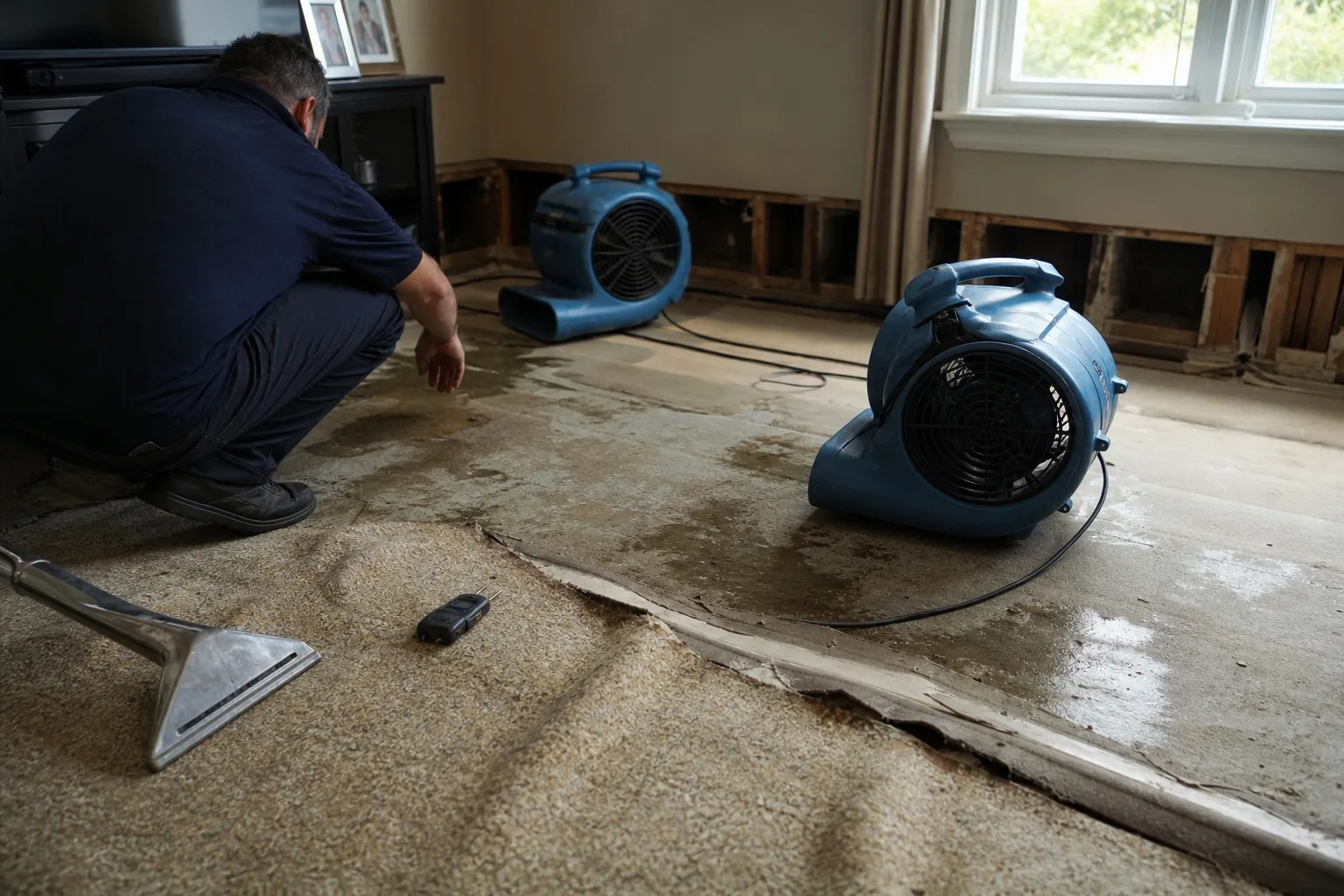
- Professional water damage restoration typically follows a set process of extraction, drying and moisture monitoring, set out in the IICRC S500 standard used across the industry.
- Water wicks up drywall and spreads under flooring while it sits, so close the source and call before it reaches the next room.
- Calls come from across Santa Monica and Los Angeles County: call the moment you see water, not after it stops.
1
Restoration needs
Water, storm and related property damage can each call for a different kind of work.
2
Local conditions
Water damage in Los Angeles County depends on local climate, construction and flood patterns, so those are set out below.
3
Call before it spreads
Close the source and keep clear of wet outlets. Then call: drying starts sooner, and more of your home stays in place.
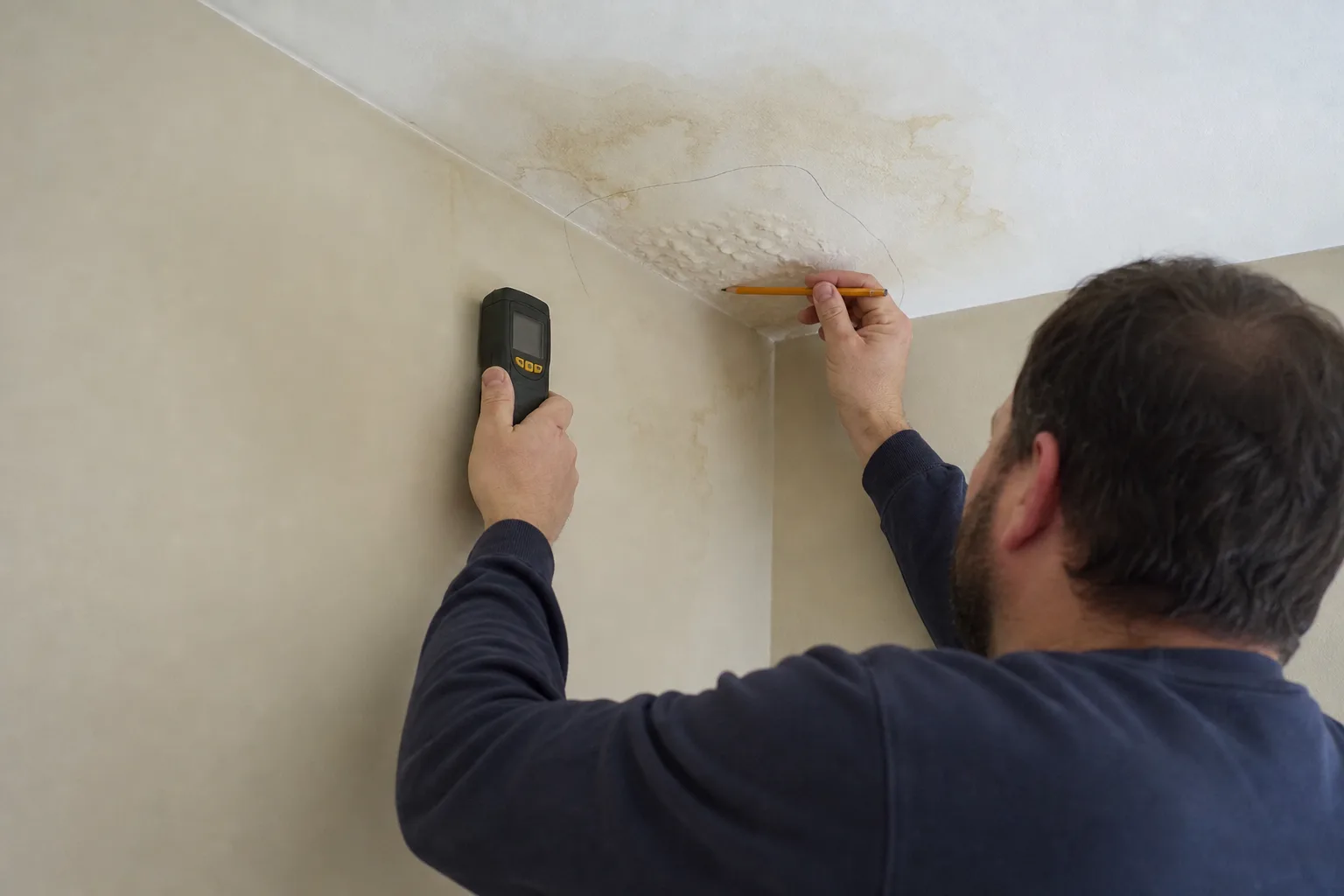
Staining shows only part of where moisture has traveled.
Recognise the problem
What you can see, and what the building is hiding
The visible signs of water damage in a Santa Monica property are the first column. The second is what moisture does inside the structure after the surface looks dry.
Service categories
Most requested
Immediate signs
- Standing or pooling waterOn a floor, in a basement or garage, or against an outside wall.
- Wet carpet, padding or flooringPadding holds water long after the surface of the carpet feels only damp.
- A stained, bulging or dripping ceilingWater is collecting above it. Stay out from under a sagging section.
- Water near outlets, appliances or the panelKeep clear and keep power away from the wet area before anything else.
Hidden structural risks
- Moisture in wall cavities and under flooringA floor can feel dry while the subfloor below it is not; only moisture readings settle it.
- Swollen baseboards, cupped boards, loose tileMaterials move days after the water stopped, which marks where it traveled.
- Musty odor and surface growthDamp materials left in place can support mold, which is why drying is not optional.
- Softened drywall, rusting fasteners, sagging insulationSlow damage that surfaces long after the first leak.
Local conditions
What shapes water damage in Santa Monica
Coastal flood zone at the beach
Water and terrainFEMA maps a 100-year flood zone along Santa Monica's coastline, about 0.6 square miles or roughly 7% of the city, where the City's hazard mitigation plan says intense rainfall combined with high tides and storm surge can damage beach-area properties.
Storm water at the beach edge of the city arrives as salt water or street runoff, which soaks slab edges, wall bases and ground-floor finishes and counts as contaminated.
Keep out of water that came in from the street or the beach, and call once it crosses your threshold.
Marine layer on the bay
ClimateSanta Monica sits on the coast under the marine layer: cool, moist ocean air held beneath warmer air, which keeps the coast gray and cool on late spring and early summer days when inland areas turn hot.
Cool, damp outdoor air does little to dry a wet wall or floor, so soaked drywall, framing and flooring stay wet longer than they would inland.
Open windows will not dry a soaked room near the coast, so call for professional drying before the moisture sets into the framing.
The process
Delay and guesswork against a standards-based protocol
The right-hand column follows a published standard such as IICRC S500. The left shows what tends to happen when water is left or handled without readings.
| Stage | Delay or DIY hazard | Standards-based extraction protocol |
|---|---|---|
| Standing water | Soaks into padding, baseboards and the base of the walls while it waits. | The bulk of the water is removed first, with industrial extraction. |
| Is it dry? | A floor that feels dry can still hold moisture in the subfloor beneath it. | Moisture readings are taken and repeated until materials reach a dry standard. |
| Airflow | Closed rooms and household fans move wet air around without removing it. | Drying capacity is matched to the room, its materials and its readings. |
| Wet materials | Left in place, they swell, stain and can support mold. | Porous materials that cannot be dried are removed and discarded. |
What you are seeing
Standing water, a spreading stain or smoke residue: sort it first
Tap water is a property problem. Water from a drain, the street or the beach is a health problem first, and a ceiling holding water is a safety problem before either.
- Clean water indoors
Standing water and soaked carpet from a household line call for Water Extraction and Drying.
- Rain or street water
A roof leak or runoff under your front door is Storm and Flood Damage.
- A failed pipe, hose or drain
That is Pipe, Appliance and Sewage Water Damage.
- A shared or empty building
Condos, rentals, vacant homes and businesses fall under Property-Specific Water Damage.
- Soot and hose water
Fire and Smoke Damage Restoration treats both together.
Safety protocol
Check for danger before you step into the water
A wet room can injure you before it ruins anything you own. Rule out these hazards first:
- Electricity
Stay out of any room where water has reached a socket, a power strip or a plugged-in appliance.
- A sagging ceiling
Keep everyone out from under it, because soaked plasterboard can fall without warning.
- Gray or black water
Treat it as contaminated and keep your children and pets away from it.
- After a fire
Wait outside until the fire department clears your building for entry.
Close the main shutoff if you can get to it safely, then call: what comes out of your Santa Monica floor today never soaks into the framing.
(424) 437-1293Restoration scope
Water Extraction and Drying: clean water in floors, walls and ceilings
A faucet connector let go, a tub ran over, or water from upstairs came through your ceiling. Water Extraction and Drying is the core of emergency water damage restoration: the liquid comes out first, then the dampness your building absorbed.
- Extraction
Commercial extraction removes standing water from carpet, tile joints and the layers under them.
- Moisture readings
Measurements show how much farther the water spread than the mark you can see.
- Structural drying
Sustained professional drying brings your studs, plaster and slab down to the level of an unaffected room.
- Selective removal
Materials too saturated to save come out, so everything behind them can dry.
What you are seeing
Storm and Flood Damage: rain through the roof, runoff at the door
Rain is dripping through a light fitting, runoff has come in under your front door, or the plaster below a window is wet after a night of wind. Storm and Flood Damage begins outdoors and finishes inside your ceilings and floors, and it brings soil and street grime with it.
- Roof leaks
Rain saturates the attic insulation first, and the ring on your ceiling marks only the lowest point.
- Flood water
Runoff that enters at ground level soaks each wall it meets and the flooring between them.
- Wind-driven rain
Water forced past a window or door frame seeps into the wood around the opening.
FEMA maps a 100-year flood zone along Santa Monica's coastline, where the City's hazard mitigation plan says intense rainfall combined with high tides and storm surge can damage beach-area properties. Keep out of water that came in from the street or the beach, and call once it crosses your threshold.
What you are seeing
Pipe, Appliance and Sewage Water Damage: the source sets the risk
A pipe split inside a wall, a washer hose failed, or a drain backed up into your tub and over the bathroom floor. Pipe, Appliance and Sewage Water Damage keeps growing until the source stops, and each source ruins a different part of your home.
- Burst and leaking pipes
A failed line hidden in a wall saturates the framing before any mark shows through your paint.
- Appliance failures
Water heaters, washers, dishwashers and refrigerator lines let water go under counters.
- Sewage backups
Waste water carries bacteria into anything absorbent, so the soft flooring it soaked has to go.
Repairing the pipe or clearing the drain is plumbing work. Mitigation deals with what the water left: your wet floor, the rooms beside it and the ceiling underneath.
Property type
Property-Specific Water Damage: who else the water reaches
Your leak may not stay yours. Property-Specific Water Damage depends on the building: who lives under the wet floor, who is on the other side of the wall, and how long the water ran unnoticed.
- Condos and apartments
Water passes through party walls and floor assemblies, so one leak can soak several households and the corridor between them.
- Rentals and investment property
A tenant may mention the mark well after the leak began.
- Vacant and seasonal homes
With the house empty, a slow drip has time to ruin entire rooms.
- Businesses
Commercial water damage adds closed doors and ruined stock to the drying.
Alert your property manager or the people downstairs, then call before the water gets into another unit.
Restoration scope
Fire and Smoke Damage Restoration: soot above, hose water below
Soot coats your walls and counters, the smoke smell has reached rooms the fire never touched, and the water that put it out is still in the floor. Fire and Smoke Damage Restoration deals with both at once, because residue etches your finishes while hose water soaks the ceilings and framing.
- Soot and smoke residue
Professional cleaning lifts residue from walls, ceilings and contents before it stains them for good.
- Smoke odor
Odor treatment reaches the porous materials that hold the smell.
- Firefighting water
Extraction and structural drying clear the water left in floors, walls and ceilings.
Call once the building is cleared, before the soot sets and the water spreads.
Loss risk
What you lose while the water stays in the building
The puddle is the part you can see. The bigger loss is the water your walls and floors have already absorbed, which keeps rising behind the paint after the surface feels dry.
- Walls
Soaked plasterboard goes soft and sheds its paper face, and a wall that could have dried is cut away instead.
- Wood floors
Planks warp and separate once water gets under them.
- Structure
Lumber that stays damp starts to rot, and the job outgrows drying.
- Water quality
Clean water goes foul as it stands, and more of what it soaked has to go.
Documentation
Photograph the damage before anything moves
Photograph every wet room, the source and the waterline on your walls and furniture before anything moves. Those pictures, with the moisture numbers from first day to final result, record what the water damaged and when it dried.
Triage order
Why you call before the floor looks dry
A floor that looks dry proves nothing about the framing behind your baseboards. In Santa Monica and across Los Angeles County, the damage hidden in your walls is usually wider than the mark on the paint, and it grows while you wait.
Shut off the source, avoid anything electrical, take your photos and call about water damage restoration in Santa Monica. Extraction that begins while the water is still liquid decides how much of your home you keep.
Housing stock
How Santa Monica buildings take on water
Older multi-unit buildings
Housing stockMore than three in four Santa Monica homes are in multi-unit buildings, and the vast majority of the city's housing was built before 1980.
In a multi-unit building, water from one unit's supply line, drain or appliance runs through shared walls and ceilings into the units beside and below it, and plumbing of that age is more prone to fail.
Water from a neighboring unit keeps soaking your ceiling and walls after the drip stops showing, so call once you see a stain or a sag.
Land and weather
Water, soil and weather around Santa Monica
Coastal bluffs and canyon slopes
Water and terrainSanta Monica's coastal bluffs rise about 50 to 150 feet above the beach, and the City's hazard mitigation plan reports slope failures after intense rainfall there and on the slopes bordering the Rustic Creek and Santa Monica Creek canyons on the city's north side, some of them as mudslides.
On a lot below or beside one of those slopes, saturated soil and runoff carry mud against the wall and into low rooms and garages.
Mud holds water against the base of the wall long after the rain stops, so call once runoff or mud reaches the building.
Atmospheric river storms
ClimateThe City of Santa Monica's hazard mitigation plan ties coastal and urban flooding in the city to atmospheric rivers, and it records the storm of February 4 to 8, 2024 as a slow-moving atmospheric river that dropped 6 to 12 inches of rain on the Southern California region.
Rain of that volume over several days finds every weak point in a roof, a window or an exterior wall, and it keeps feeding the leak for as long as the storm lasts.
Water that gets in during a long storm keeps soaking the wall and ceiling behind the stain, so call once a stain or a wet wall appears instead of waiting for the rain to end.
Service area
Serving Santa Monica & Los Angeles County
Coverage radius
Covered ZIP codes (11): 90401, 90402, 90403, 90404, 90405, 90406, 90407, 90408, 90409, 90410, 90411
- I-5, I-605 and CA-60: I-5, I-605 (the San Gabriel River Freeway) and CA-60 are major arterials through Los Angeles County.
Congestion or a closure on one of them lengthens the route to a property, and a longer route is more time for the problem to get worse.
Call as soon as you notice the problem, before traffic on these routes adds to the wait.
Not sure your address is inside the coverage area? Call: the address of the damage confirms coverage.
Questions
Santa Monica water damage — FAQ
What should you do first when water is spreading in your Santa Monica home?
Shut off the water at the main valve if a pipe or an appliance supply line is the source, and stay out of any room where water is near outlets or cords. Move people and pets out of the wet rooms. Then call before the water reaches the next room or soaks through to the floor below.
Is it safe to stay in a room with standing water?
Not when the water reaches outlets, cords or a power strip: leave the room, stay out of the water, and call from a dry spot. Treat water from a backed-up drain, a sewer line or outside flooding as contaminated, and keep children and pets away from it. Call 911 if anyone is hurt or a ceiling sags over people.
Why does it matter how soon you call about wet floors or walls?
Water keeps moving after the surface looks dry. It wicks up drywall, spreads under flooring and soaks into insulation and subfloor, and the longer it sits, the more material you lose. Calling promptly keeps the damage limited to what you can see.
What happens to water you cannot see?
It runs under your flooring, behind baseboards and into wall cavities, and soaked drywall and subfloor keep releasing moisture long after the surface dries. Water from a drain backup carries contamination into every layer it reaches, so call before hidden water spreads into your framing.
What records should you keep for your insurer?
Take photos and video of every wet room, the source and your damaged belongings before you move or throw anything out, and keep any failed part, such as a burst supply line. Your insurer decides what your policy pays for, so ask them directly.
Which parts of Santa Monica and Los Angeles County can you call about?
Any address in Santa Monica and the surrounding Los Angeles County area, including homes and businesses near the city line.
Water damage keeps spreading until it is dried.
Call from Santa Monica before the water reaches the next room, the subfloor or the framing behind your walls.