
Seepage starts where wet soil outside presses water against your foundation. The moisture finds a hairline crack, a cold joint or a pipe sleeve, then comes through so slowly that you notice the damage before you notice the water.
Service · Santa Monica, CA
Foundation Seepage and Wall Leaks in Santa Monica, CA
Water is seeping through your foundation, darkening the bottom of the wall or beading on the slab after the rain. Foundation seepage and wall leaks send moisture into the base of the structure from the outside, where it wicks into drywall, framing and flooring before you see a puddle. Professional drying stops that spread, so call once the wall bottom turns damp.
What you are seeing
Seepage that works from the outside in
Hydrostatic pressure builds when saturated ground leans on a slab, driving water up through the cold joint at the footing and the gaps around utility sleeves.
A damp band along the wall bottom: Moisture has crossed your foundation and climbed into the finish you see.
Beads of water on the slab: Your floor edge is wet and the dampness is moving inward.
Peeling paint or flaking finish near the floor: Water behind the surface is pushing your coating off.
A cool, damp feel low on the wall: Wet drywall is holding the moisture against your framing.
Stay clear of wet outlets at floor level, then call while the seepage is still confined to the base of the wall.
(424) 437-1293Safety protocol
Keep wet wiring and low outlets off limits
Stay away from your outlets and cords near a wet wall base until the power to that circuit is off. Water that works along the bottom of a wall often reaches your lowest wiring first.
Loss risk
What seepage does behind the surface
Seepage is patient damage. Small amounts of water enter again and again, and your wall never gets the chance to dry between wet spells.
- Bottom plates
The timber sitting on your foundation keeps taking in water and stays wet.
- Drywall and trim
The lower edge wicks moisture upward and crumbles from the inside.
- Insulation in the cavity
It holds water against the framing and lets nothing dry out.
- Flooring edges
Boards and underlayment at the wall pick up the moisture and lift.
Restoration scope
What foundation seepage work covers
Mitigation dries what the seepage soaked in your building and finds how far it traveled. Sealing the foundation, waterproofing the exterior and correcting drainage belong to other trades.
- Moisture tracing
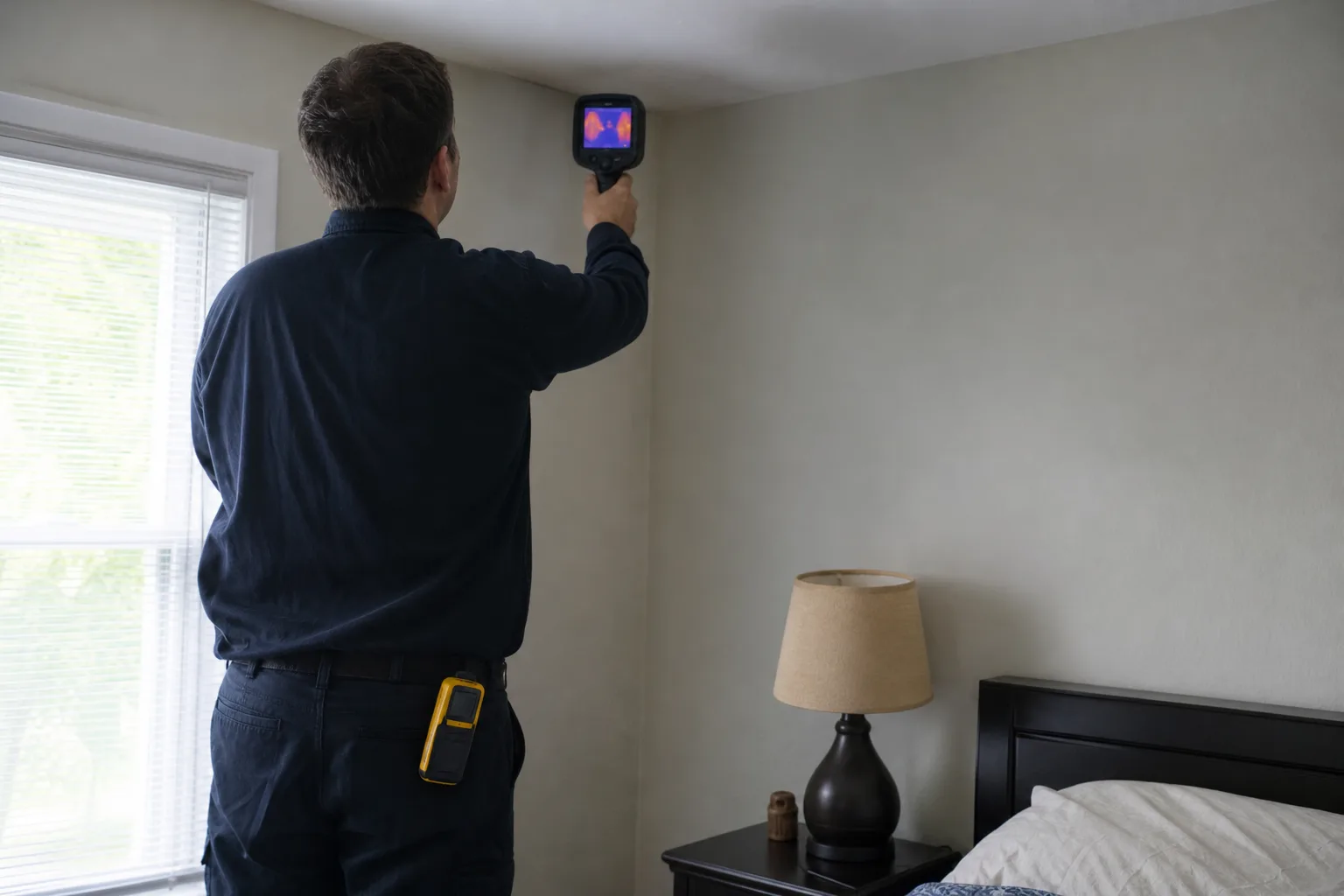
Meters follow the dampness along your wall bases and slab edge to find its true extent.
- Strip-out
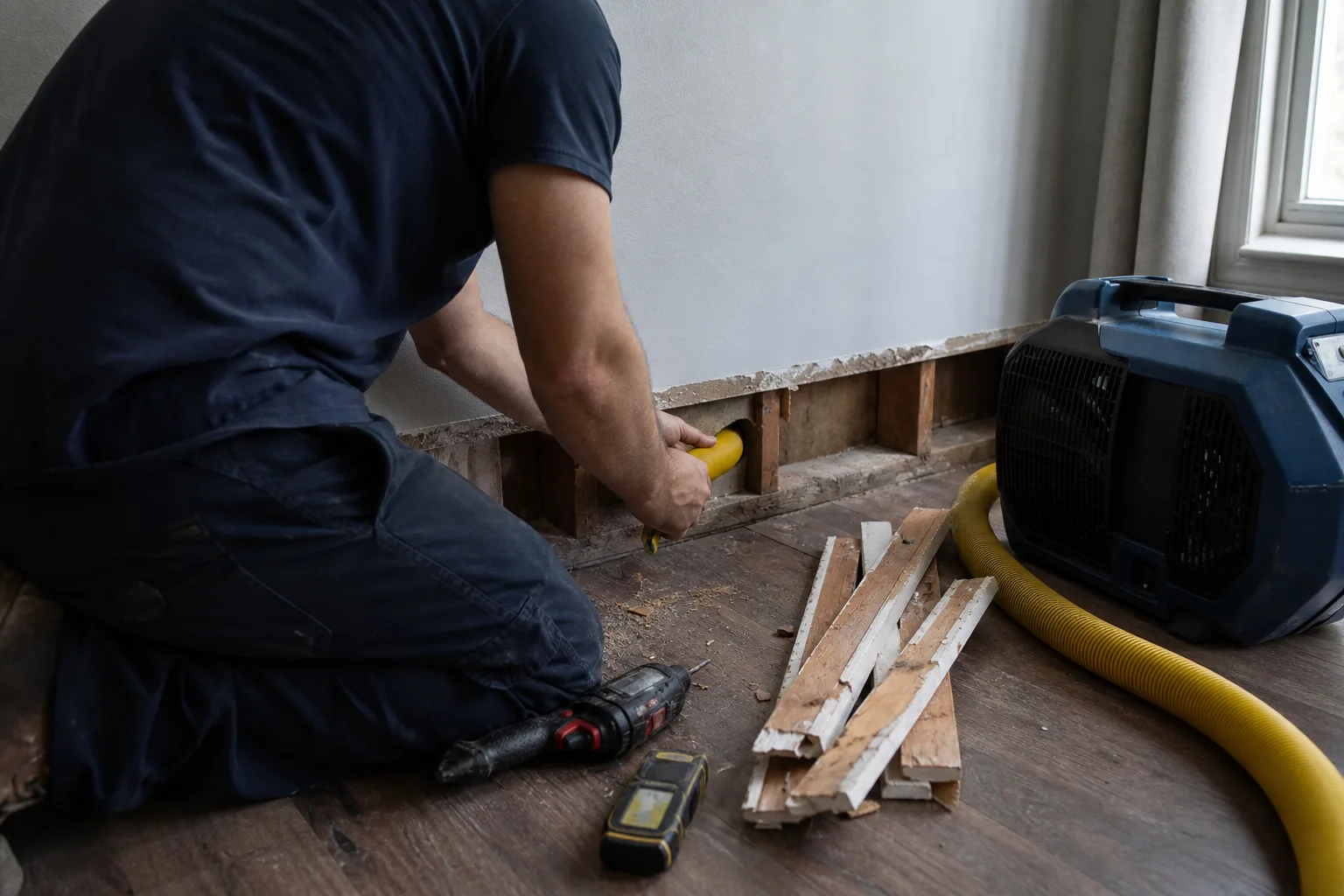
A band of soaked drywall and insulation comes off so the framing can release its water.
- Cavity drying
Controlled drying works on bottom plates, studs and the back of the sheathing.
- Slab-edge drying
Your floor edge dries until its readings match a dry part of the building.
Service sequence
How a seepage job proceeds
Trace
Meters mark how far the seepage traveled along each wall that shows it.
Strip
A band of soaked material comes off the bottom of the wall to expose the cavity.
Cavity dry-down
Controlled drying draws water from plates, studs and sheathing.
Slab edge dry-down
Your floor edge dries alongside the wall.
Close-up readings
Meters match a dry reference before anyone closes the opening.
Local detail
Older foundations let moisture in first
Most of Santa Monica's housing was built before 1980, and older foundations and wall bases tend to let moisture through first. Call once your wall bottom turns damp or your slab edge beads water, because wet framing at the base keeps its water long after the rain.
Triage order
Why slow seepage still needs your call
Seepage that has gone unnoticed for a season has usually soaked more of your wall than the visible band suggests. The longer it stays wet, the more of your drywall, trim and flooring has to be replaced.
Seepage often works along a cold joint or a utility sleeve for a full season before a stain appears, so a lower wall can hold far more water than the visible band suggests.
Call about foundation seepage and wall leaks in your Santa Monica home in Los Angeles County when your wall base first turns damp, while your framing can still dry.
Scope: Emergency extraction and structural drying clearance only. Structural rebuild and finishing carpentry are contracted separately.
Service area
Santa Monica ZIP codes
- 90401
- 90402
- 90403
- 90404
- 90405
- 90406
- 90407
- 90408
- 90409
- 90410
- 90411
Every responding technician is independent. Before work begins, confirm the technician's license, insurance and pricing with them directly.
Common questions
Foundation seepage and wall leak questions in Santa Monica
Is a damp wall bottom worth a call?
Yes. The damp band you see usually marks wet drywall, insulation and framing behind it, and it keeps spreading while the moisture stays.
Does the work include sealing the foundation?
No. Mitigation dries what the seepage soaked. Waterproofing, sealing and drainage correction belong to other trades, who work on their own schedule.
Why does seepage come back after the wall looks dry?
Your surface dries first, while the bottom plate and the cavity keep their water. Meter readings show whether the structure itself is dry.
Water damage keeps spreading until it is dried.
Call from Santa Monica before the water reaches the next room, the subfloor or the framing behind your walls.